Hi Folks, this is a long overdue post. First of all, I would like to thank Amy Wu for her patience and willingness to impart her knowledge on genetic studies, as well as her personal experience! I will be summarizing the beginning of my "Orange Pudding Hamster Project," the learnings I had, and my thoughts from the Summer × Autumn litter as an ethical breeder. This is my journal....
Getting the pair
Both Summer and Autumn were gotten at the same time on the 15th of August 2015. They are from two different families, with Summer being a week older than Autumn. The first step is knowing the pair’s heritage line. Summer is Orange Pudding × Orange Pudding + Sapphire WW sibling, while Autumn is Yellow-Blue × Yellow-Blue. It is really important to establish the pair’s lineage before breeding, as my goal is "to achieve healthy, well-tempered Orange Pudding hamsters with stable and even colouring."
Getting to know them
I was very excited to welcome them into the family, as it had been close to two months of searching for the next perfect hamster since Dawn’s passing, and now having two hamsters at once. Summer and Autumn are two poles apart in terms of characteristics; Summer is like the warm sun, friendly and laid-back. Meanwhile, Autumn is full of energy, running like the wind. Even so, I still love both of them.


Grooming them
As much as I would like to breed them, there is a responsibility and a moral standard to uphold. They are not just hamsters; they are pets that depend on you; it is a life in our hands. Just like any mother, I wish for them to be at their very best: ensuring they are in healthy condition, giving them lots of love and attention, and providing a quality living environment. All these are just the basics that we should provide and treat all hamsters alike or more accurately, must have.
The harder parts are the internal factors to consider, such as chronic illnesses and genetic defects (diabetes, tumours, stargazing, etc.). It is even more difficult to identify these, as both Summer and Autumn are very young and less likely to display symptoms. All I can rely on is the information provided by their previous owners, who might not even be aware, as their hamsters could be carriers who do not show symptoms. Beyond that, I must remain vigilant in observing their behaviour, as any suspicion would be far too risky to continue with the project. Fortunately, both of them are in tip-top condition.
Temperament places a huge emphasis for me. No one likes an aggressive or skittish personality, even if the hamster is beautiful. Imagine a dazzling peacock that comes dashing and pecking at you whenever you are within its sight—it would not be a pleasant encounter... or a rainbow-colored fish that always evades you, such that you cannot even have a proper look at it. You may argue that fish are for viewing and not handling. My reply would be: "Hamsters are not ornamental pets; they benefit more from interaction." I am more than willing to delay the project if their temperament is not suitable, as this also ensures that poor temperament is naturally eliminated over time. It is truly a pleasure to have both Summer and Autumn be perfect in their own way.


Preparation Studies
I did not take biology as my core subject, to gain a better understanding, I sought help from some renowned overseas hamster breeders, and Amy has offered assistance in more ways than I expected.
To backtrack a little, some may question if I have researched and handled hamsters for so long, why would I still seek help from others, and especially from an overseas expert? I have indeed handled hamsters for seven years, but this is my first time breeding, and the hamster is a Mandarin (Orange Pudding), which is still not widely studied. You may have extensive theoretical knowledge but zero practical experience, which can lead to many unforeseen scenarios.
Why overseas? Not to blame or accuse anyone, but many people stereotype breeders as unethical owners. Instead of offering relevant information, they may pressure you to stop all activities and give the usual advice that breeding is bad, and so on. Personally, I neither advocate nor condemn breeding, but I feel that if an owner is well-prepared in terms of knowledge and planning, understands the consequences, and takes full responsibility for the welfare of their pets, they should not be deemed as sinners.
Besides, learning from someone with extensive personal experience, someone who has been through many different situations is invaluable, especially since there is a limit to what books can offer, which often only cover common scenarios. Through my conversations with Amy, I came to realize how much gap I had and brushed up on basic biology, principles of inheritance, Punnett squares, genotyping (which really strains my brain), and homozygous versus heterozygous traits.
She was also quick to point out that, given I am dealing with a hybrid line, I need to be even more cautious, as the lineage is unclear and there may be hidden risks. It is also vital that I have access to a vet who can perform an emergency C-section. That was the first time I learned that hamsters can even undergo a C-section and it made me wonder if there is one available in Singapore!
Love you, Amy! You have shared so much information that I would never have been able to access on my own.
Reference Source:
http://www.dwerghamster.nl/russische/kleuren_en_mutaties/index.php
https://web.archive.org/web/20131225102709/http://home.comcast.net/~cricetus/genetics.htm
 Mating & Pregnancy
With all the information gathered, I was ready to proceed. Summer and Autumn had long reached maturity, but I waited until they were six months old to ensure they were truly ready to handle parenthood. Partly, I also wanted to observe Summer in his “stable colour” (Puddings are brighter when young and will fade to a lighter shade or brown, finalizing their colour only upon maturity). My goal: healthy, well-tempered Orange Puddings with even colouring.
I chose the day before Chinese New Year Eve as their “wedding night.” It felt appropriate—they had reached the right maturity, and the New Year represents a new beginning for all. I did not have to wait long, as Summer seemed to have been awaiting this reunion. Coincidentally, Autumn was on heat as well. I had a good feeling it would be successful, especially after spotting their lovey-dovey interaction, and sure enough, the day after next, Summer was chased away by his newly wedded wife. Oops!

Having said its too early to know if it is a success, it could only be confirmed when the babies were born. Time would tell, in about 18 to 21 days. Ten days later, I began to doubt myself… Autumn was still as active as usual, with no signs of hoarding. Another two days passed—hmmm, is she getting fatter, or are my eyes playing tricks on me? At the 15 days mark, Autumn started giving very clear signals. She began building a nest, busily moving in and out, and became more agitated; the stroking rule now became “time’s up when I bite.”
On the 17th day, I did a full clean-up, knowing I would have to go without cleaning for at least two weeks—hopefully without any water bottle flooding. This was also the last time I handled her outside the tank, and I took the final baby bump photo—a beautiful pear shape! On the 18th day, I was filled with anticipation, but nothing happened. Well, a delay is normal. Another day passed, still no movement. Now I was getting worried, imagining all the worst-case scenarios; are the babies too big? Does the mother not have the strength? The only comforting thought was that Autumn was behaving normally, not showing any signs of pain or distress.
Welcoming & Nurturing
Finally, on 25th February 2016—the long-awaited moment! Autumn safely gave birth to seven little jelly beans! Seven babies were more than I had expected, and I was a little worried that it might be too much for a first-time mother to handle. All that worry was unnecessary. Autumn is a natural mother, knowing exactly what to do to ensure all her little ones are well taken care of. I am overjoyed and so proud of my little mama!
For the first few days, I gave Autumn and her children complete privacy, keeping my distance except for a quick snapshot when she came out for her meals. In general, Autumn trusts me enough to tolerate photography. Even so, I made sure the sound was off and only took photos when she was completely knocked out or taking a break. It was also a pleasant surprise when she moved her babies from under the platform to an open area. Perhaps it was more spacious and well-ventilated, and she did not feel threatened enough to keep them hidden away.
By day five, the babies began developing their undercoat, and their colours could be differentiated. It was very fortunate that we had five puddings out of seven babies—that’s more than half! They grew up incredibly fast, from wriggling jelly beans to mini hamsters stumbling around, from the first moment they held solid food in their tiny paws, to when they fully opened their eyes and began their adventures, and finally when sibling squabbles started.
In the meantime, there were also some hilarious moments with Autumn. The “headache” of motherhood meant no personal time. She was often spotted napping far away from her pups in the afternoon, while the babies cheekily dug food out of her mouth!
Nonetheless, I love each and every one of them dearly and can hardly bear to let them go. However, keeping them all would compromise their future. The happy family bond will come to an end once maturity sets in and it would turn into bloodshed. Now, I am faced with an internal conflict - “Who will be my keeper?” From the start of the project, I had planned to keep one for the next generation, but when the time came to decide, it felt harder than any exam question. Male or female? Colour, chemistry, or potential? (I have three males and two females—successor of Dawn or Summer?) I will share more on this at the end.
Rehoming
It is truly a blessing that Autumn and I have done everything right, all seven babies survived and are growing well. From the very beginning, I knew rehoming would be a great challenge, and the Sapphire sisters would likely attract the least interest.
Once I confirmed to proceed with this project, I gave a heads-up to some of my past boarders, asking if they would be interested in being part of it. When the babies reached 20 days old and were safe to handle, I began photo sessions and activated adoption notices on social media. The posts listed their details, along with my requirements: a photo of the prepared cage, their intended food, and an adoption fee.
The response was far more immediate than I expected but not all were sincere, and some were even dubious. Please allow me to vent a little. It truly blows my mind how little some people understand about hamsters. Some would ask if they were Syrians… Umm, what? I wish people know that dwarf and Syrian hamsters are different, with very different care requirements. On top of that, it shows a lack of effort in even reading the post.
There was also a group of people who disappeared the moment I asked for photos of the cage setup before adoption. Then some were very eager until I mentioned the adoption fee. Responses like “Oh, I thought they were free,” or “I need to check with my spouse,” or “That’s expensive” which really made my blood boil. Seriously?!
Firstly, given the time and effort I’ve put into research and proper care, how could anyone expect them to be free? Treating them like sale items is honestly unsettling. Secondly, shouldn’t your partner or family already be aware before you even make an inquiry? At best, they hesitate due to the responsibility; at worst, the pet will be given up later.
Lastly, I believe my pricing is fair, it is nothing compared to pet shops that create fancy names and attach exorbitant price tags. Setting a higher benchmark is not about profit, ethical breeders do not earn from this. With the time needed for hamsters to mature, the breaks between pregnancies, the cost of quality food, and the commitment to never abandon or “clear stock,” it is far from profitable. Another factor is that pudding hamsters are uncommon locally, and free or cheap adoptions could attract ill-intentioned individuals who may resell them or exploit female puddings for breeding.
Hence, I did not compromise on any of my requirements and did not hesitate to turn down adopters who seemed insincere. Fortunately, there is always a silver lining and four of my hamsters have found good, loving, forever homes.
P.S. It never gets bored in receiving updates from their owners and staying connected with them 🙂
Lots of LOVE
As of today, my fur family has expanded from 2 to 4 + 1. My two keepers are Mizar (male) and Alcor (female). As mentioned earlier, it was a tough choice and I gave in to temptation, ending with two keepers instead of one ;P
I was drawn to Mizar for his bright coat, while Alcor sparkled with intelligence. Partly, I also knew I wouldn’t be able to predict whether their future match would be male or female.
 |
| Autumn |
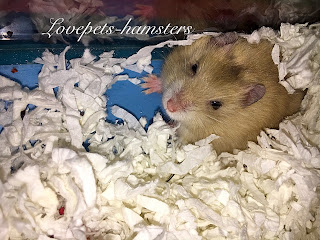 |
| Alcor |
 |
| Mizar |
 |
| Summer |


.jpeg)
.jpeg)
.jpeg)
.jpeg)

.jpeg)

.jpeg)


.jpeg)